Essential Fantastic Four runs now that the Hickman run is over
With the Jonathan Hickman era on the Fantastic Four completed, and a new surprisingly good creative team starting up, I thought a review of some of the best runs of “The World’s Greatest Comic Magazine” might be in order.
Stan Lee & Jack Kirby – 1961 to 1970
Originally released in 1961, the Fantastic Four (labeled as “The World’s Greatest Comic Magazine” with issue #3), created by Stan Lee and Jack Kirby, was not an overnight hit. While it was the most popular Marvel book within a few issues it did not become a monster hit for quite some time. Stan and Jack created the vast majority of what fans know today as the Marvel Universe but The Fantastic Four was unlike anything ever seen before. From the story to the characters, even down to the art and layout, Fantastic Four was the richest, most fertile ‘new’ ground broken in the last 25 years. The first 100 issues or so of this book contained some of the most amazing stories of the era. Stan and Jack worked on this book together for nearly a decade and gave the “House of Ideas” its name.
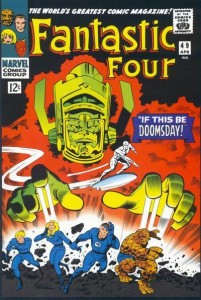
In a modern context these stories are a bit of a mixed bag. Stan Lee was the perfect writer for the 1960’s but reading these today can be an irritating experience if you are not in the right frame of mind. The plots were generally well done but the dialog is SO dated and even a little hokey that these books can really bug a modern reader. “This is what everyone is so high on?!” is what I would often hear from someone reading these for the first time. The stories are surprisingly wordy in comparison to other books of the day. Marvel had a real need for exclamation points and even the most mundane conversations were peppered with them. These comics are a fun read and a good example of the best written comics of the 60’s but they need to be taken with a small grain of salt.
Many younger fans, there are very few Kirby fans between the ages of 15 and 20, will not care for the art. The very young look at Kirby’s art and see dynamic action and motion, but once you get to the jaded teenage years, the art can lose its appeal. Many young readers do not get the context and will feel what they are seeing just seems dated. As the fan matures they rediscover what they originally loved about the art and begin to appreciate Kirby’s style and skill. It is only as we get older and our visual sense gets more sophisticated that the art shows us the dynamic power and magic within. Jack Kirby is one of the foundations of modern comics. If you take out the characters he either created or helped to create, Marvel would not exist. The entire language of comics owes a tremendous debt to Kirby’s work. Kirby’s career spanned the entire history of comics up to his death in 1994 and he has even been credited with creating the entire romance comic genre. Well known comic concepts and iconography from the 1930’s up to today would simply not be there without Kirby’s work.
Reading these books lets you touch history itself and no, I am not overstating. There are many people who were vital to the creation and development of the comics medium but get all of them in a room together in the afterlife (as most of them are now gone), and they will all point to Jack as ‘the guy’. There was a reason he was called the King. The entire Lee/Kirby run is available in several different collected formats and there needs to be no other excuse to read them.
John Byrne – 1980, 1981 to 1986
Suddenly in 1970, Kirby left Marvel and the Fantastic Four behind or at least from the fan perspective that’s what happened. With his departure the magic was gone from the book. Lee kept writing for a while, working with many great artists, but it didn’t seem to matter. Eventually Lee left the book and other writers tried their hand at it. Many of them were very good writers but the book went into a decade long decline. There were good issues and story arcs in the mid-70’s and some very talented creators but they just could not recreate the magic. It seemed that copying Lee and Kirby was the only real goal but no one could match their success. It was not until John Byrne took over the writing and art on the book in 1981 with issue #232 that things improved.
Byrne successfully merged the Old with the New. He loved the Lee and Kirby stuff and it shows but he never let the ongoing homage to the Lee/Kirby era get in the way of a fun, well told story. The high point was the Nova/Frankie Raye storyline in issues 242 to 244 where everything meshed flawlessly. In these issues, Byrne gave a master-class on how to create a strong, well-crafted character. There was no reason a reader should have cared about Frankie who was a very new character to the book, but you did.
It was in the Byrne run that the Invisible Girl became the Invisible Woman and finally started to be something more than a potential hostage and liability to the team. We also learned more about Franklin and his powers and why Reed has never been able to cure Ben. Byrne left the title with issue #293 after an amazing run. His entire run is collected in the Visionaries series of reprints and some Omnibus hardcovers.
A lot of people have asked Byrne if he would ever go back to the book. His answer is always the same…
“One of the things I have realized from reading umpety-ump postings here On Line is that my work on the FF has been elevated far beyond its proper station. Sure, it was mostly good stuff, and some of it even flirted with greatness, but in many respects it shines because of the ol’ Tiberius/Caligula scenario — it looks so great because so much that followed was dross. Thus I face a terrible problem: if I were to return to the FF I would not only be expected to instantly “save” the book, I would be expected to “return” to those grandiose heights which I never really achieved in the first place! Frankly, I can live without that kind of pressure!” (1/4/98–Byrnerobotics.com)
Hit ‘NEXT’ for more of the greatest FF runs…
Walt Simonson – 1989 to 1991
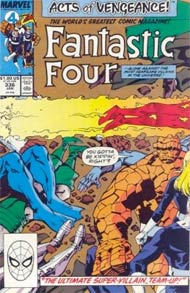 Walt Simonson transforms every book he works on into a very different animal and the Fantastic Four was no exception. With Walt, Reed and Sue became a focus. Simonson had a number of stories ready for these characters from his time on the Avengers, where he had planned to use Reed and Sue, but was told they were not available. The family, so important in all the best runs, was a centerpiece and Simonson’s quirky visuals gave the book a hard fantasy look that felt like a visual link back to the Lee/Kirby era. Like Byrne a few years earlier, Walt did it all. He wrote wonderfully odd and fun stories while doing all the art on almost the entire run. For most creators this would have been monumental but Simonson, like Byrne, made it look easy. Maybe that is the real sign of a good 1980’s comic that it appears to have been as fun and effortless in its creation as it was to read.
Mark Waid & Mike Wieringo – 2002 to 2005
After the monumental runs of Byrne and Simonson there were several years of talented people doing derivative work on the Fantastic Four. It was not a lack of creativity from the teams just more that no one ever really “got” the book. They were either trying to imitate Byrne or the Lee/Kirby run or trying to be completely different, usually with disastrous results. Tom Defalco had a lengthy run on the book some of which was quite good. Unfortunately every time he seemed to be going somewhere interesting, the book became repetitive by yet again falling back on the same old tropes that were now well worn.
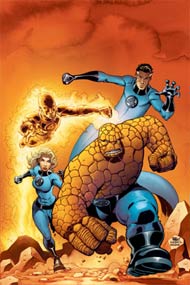 Mark Waid started up with the renumbered issue #60. Waid “got” the book. It was still a ‘family’ but that is really all he kept from earlier versions. Waid didn’t negate old stories and continuity rather he just addressed what he needed to tell his story. The depths of character he added to the main four, and even to Reed and Sue’s young son Franklin, makes this a really funny and powerful run. As with all Marvel runs of any length, Waid had to contend with interference from on high and it nearly cut the run short. Fan outcry saved the creative team and they were able to finish the story they were trying to tell. Waid gave the characters life and let the reader believe the everyday aspects of FF’s lives right along with the outlandish. It is interesting to note that the action scenes really do derail the more interesting elements of the team’s everyday life. The reader finds them self caring less for Doctor Doom’s new plot than about Johnny’s attempts to run the family business. Unfortunately nothing could save the series from the mediocrity that would reclaim it after Waid left.
Jonathan Hickman – 2009 to 2012
Many creators have had plans to save this title from becoming second tier and all have failed, some more miserably than others. There were germs of amazing ideas that were not very well executed, a real theme at Marvel in the last decade it seems. Then along came Jonathan Hickman. In many ways his run feels like the earlier Waid run. The people are the most important aspect of the adventure. The trouble they get into is just an extension of who they are and the lives they have led. I’m sad to say that this run has recently reached its end but after a three-year run and a spin-off book called simply FF, this will go down as one of the great runs in the Fantastic Four’s history. With five decades of this title in the can, that is a statement all by itself.
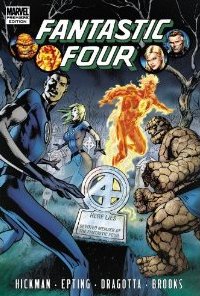 Many writers try to turn the status-quo of an ongoing title upside down, usually with incomprehensible results but not so here. Marvel’s first family loses quite a lot along the way including a family member. The past haunts them every day and old villains become reluctant heroes alongside them. The spin-off book FF is even more challenging to the old ways of writing these characters focusing on the kids and a group called The Future Foundation. A purely organic spin-off, FF was a funny and touching book that reminded me of the classic series called Power Pack. FF even shared some members with that long forgotten series (Alex Power and Franklin).
Many writers in the book’s past loved the IDEA of the book without feeling anything for the characters or caring about the fans’ reactions. With Hickman’s run fans finally get both. Fans get a story that they can get into and characters that we root for and empathize with. There are moments in this run that are completely heartbreaking and they are often unexpected ones, coming out of nowhere. I love it when a writer is not afraid to kick me in the gut.
It is easy to critique a book with all the mock expertise of the practiced fan but there is a major divide between the merely decent books and the good ones, let alone the great books. These few past runs, and I hope the new Matt Fraction run, will please fans. I cannot recommend any of them enough!
What do you think? Leave a comment.


My favorite is Byrne’s era. He had a sense to understand what made Fantastic 4 unique in the superhero world. But he was flawed, his characterization of Sue was quite weak.
think he made improvemnts to Sue as he went. She was never what she could have been, but he did a good job with her compared to what came before.
The Waid and Hickman runs make great use of Sue. She becomes the driving force for a lot of the story elements.
Bottom line is that is was Reed’s show for most of the time, so anything Sue can get is good.
Walter Simonson run is my choice. His duel with Reed and Doom are one of the best ever.
I have never read a single FF comic so I will write this as a noob! I watched both of the movies and enjoyed them quite a lot, but this article has inspired me to read the comics. I will do like this, next time I look for comics in the wild, I will pick up the first FF comic that I see, no matter which era it is from. Wishfully it will be from a good one 😉
That is risky, as there is a lot that is not very good. The Hickman run would be good or the Byrne run as they are fairly free of heavy continuity references, and even when they are there, you can get by without understanding them. The Waid run is the most fun for a noob I would think.
Excellent article. I would throw Englehart’s run in there as well. And maybe Pacheco’s.
I never read Pacheo’s, but I did like a lot of Steve Englehart’s. Some of the Len Wein stuff in the late 190s-ish was fun too.
I’ve always loved the Fantastic Four but haven’t read comics for a long time, it can be confusing as to where to start. Comments from various forum makes me excited to check out the Hickman run.
I will say, it is hard to escape the feel and vision of the 60s and 70s comic book aesthetic and even dialogue when it was created by figures of that era.